ORGANIZATIONS

One record.
And it fills itself in.

Every company you deal with, once. Prospect, customer, vendor, partner, investor or a company you hold a stake in, and often several of those at the same time. Give it a website and Cordango reads the company’s own public pages and completes the profile, filing every value with where it came from.

CUSTOMER VENDOR PARTNER INVESTOR ONE COMPANY RECORD Globex SE ONE OWNER ONE HISTORY FIG.00 — 6 RELATIONSHIPS · 1 RECORD
FIG.01

The company you deal with is not four companies.

— the problem

Business software splits a company up. The CRM has a version, invoicing has a version, the project tool has a third, and somebody keeps the real list in a spreadsheet. Ask which address is right and you get an argument rather than an answer.

That example is not invented. Two records for the same customer in our own demo company had already drifted to two different streets before anybody noticed, and nobody had done anything wrong. That is what two copies do on their own.

  • ONE One record per company, whatever role it plays for you
  • ROLES Customer, vendor, partner and investor at the same time
  • TREE Groups, subsidiaries, branches and sites as real relationships
  • OWN A named internal owner, not whoever created the row
Master data · discoveredQ3 review
# the same company, four systems > Globex SE ? in the CRM → Globex SE · owner Tomas ? in invoicing → Globex S.E. · Speicherstadt 14 ? in the project tool → Globex · no address at all ? in the supplier sheet → GLOBEX SE · Am Sandtorkai 42 ✗ one company four records · four owners · no answer
FIG.02

What a company record already is.

This is not an empty table with a name column waiting for you to design it. Organizations arrives knowing what a company is, because that part does not differ between businesses.

IDENTITY

Legal identity

Legal name and legal form, register court and number, VAT id, incorporation date. The things that settle which entity you are actually contracting with.

WHERE

Two addresses, not one

The registered address and the head office are different questions and Cordango keeps them apart, with the country from a real list rather than free text.

ROLES

What they are to you

Prospect, customer, vendor, partner, investor, portfolio company. Several at once, and none of them expires. Where a company sits in a sales process is the CRM’s business and lives on the deal.

GROUP

Groups and subsidiaries

Holding, operating company, subsidiary or branch, and the companies underneath this one. Deleting a holding never deletes what sits under it.

PEOPLE

The contacts inside it

The people you actually deal with at that company, kept separate from your own staff directory, because they are not the same thing.

OWNER

Somebody responsible

A named person in your company who looks after this relationship, from the same people records every other app uses.

TERMS

How you bill them

Billing address and payment terms, so the invoicing app does not need its own opinion about either.

SIZE

How big, how old, how funded

Headcount, founded year and funding stage, from bootstrapped through venture rounds to listed, acquired or insolvent. Filled in by research rather than by you.

Sixty-nine fields on the company record, and three quarters of them are ones you never have to type.

FIG.03

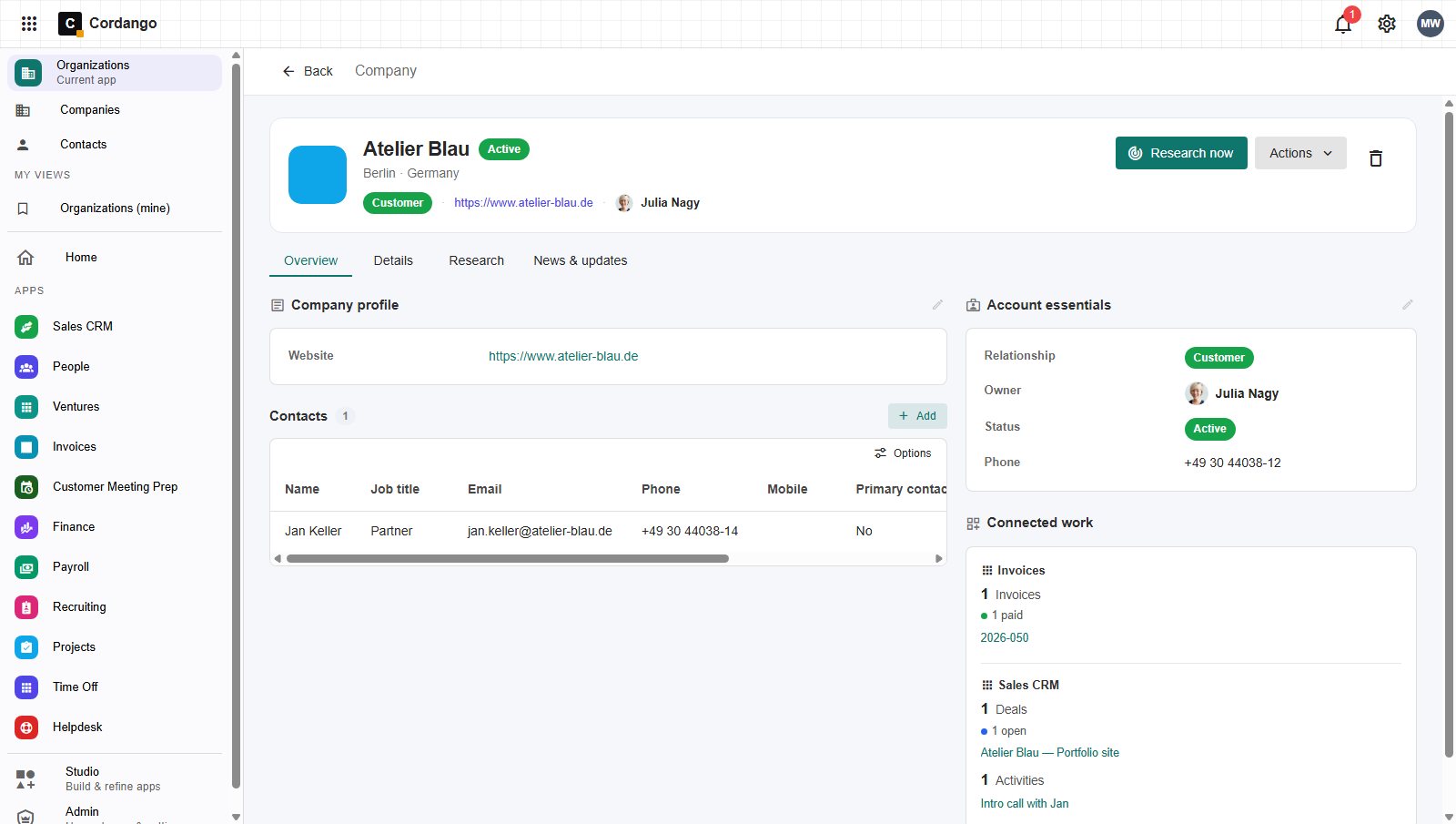
That is the actual screen.

— not a mock-up

One company, one owner, the contacts inside it, and a Connected work panel showing what every other app in the workspace holds about them. An invoice from invoicing. An open deal and an intro call from the CRM.

Nobody wired that panel up. An app appears on the company page because it references a company, which means an app built this afternoon has a place here this afternoon. And every app in the list is re-checked against your own permissions, so opening a company tells you nothing about a CRM you are not allowed to see.

  • AUTO No configuration. Referencing a company is the wiring
  • LIVE Counts and samples read from the real records, now
  • RBAC Each app re-checked against your grants, every time
Atelier Blau · one companyResearch now
FIG.04

Give it a website. It does the rest.

— the research

Press Research now on a company and Cordango goes and reads that company’s own public pages. The imprint, the about page, careers, press. In Germany an Impressum is required by law and laid out predictably, which makes it the most reliable page on any company’s site: legal name, legal form, address, Registergericht and HRB number, all declared rather than described.

The thing that makes this trustworthy is what it refuses to do. It does not search for a company by name and hope. The website you typed is the target, so there is no chance of researching a company with a similar name and filing it under yours. A record with no website simply has nothing to research.

And it never writes over you. What it finds is filed alongside what you typed, and where the two disagree you are shown the difference rather than having your answer replaced.

  • YOU The website you gave it is the target, never a search result
  • THEIRS Their own pages first, because those are the ones that are declared
  • SAFE Never overwrites an answer a person gave, on any field
  • COST Refused inside a freshness window, so a button cannot run up a bill
Research · one companyAbout 40 seconds
# Research now · atelier-blau.de > reading the company’s own pages imprint → legal name · legal form · register court · HRB about → what they do · founded careers → headcount range feeds → blog and channels, confirmed from their own site ✓ filed alongside what you typed · never over it
FIG.05

How a fact earns its place on the record.

The useful question about researched data is not whether it is there. It is whether you can tell how much to trust it. Every value on the record answers that itself.

1

You supply the website

That domain is the subject. There is no name search and no confidence score about which company this is, because there is nothing to be unsure about.

2

It reads their pages

The imprint, about, careers and press pages on that domain, plus the feeds those pages declare. Everything it read is kept and listed on the record.

3

Every value is checked

A quote has to appear in a page actually fetched, it has to be a statement rather than an instruction, and it has to support the specific field it claims to fill.

4

It says how it knows

A quote and a link where one exists, and plainly nothing where one does not. An empty source column is a signal, not an oversight.

5

Your answer wins

An empty field gets filled. A field you answered is never overwritten, by this run or any future one. A disagreement is recorded beside your value for you to look at.

A value it cannot re-establish is left alone rather than blanked. Unknown means this run did not find it, never that your answer was wrong.

FIG.06

What comes back.

Enough to segment a list, spot a company worth calling, and walk into the call knowing who you are talking to.

MONEY

Funding and stage

Rounds with date, type and amount, the investors behind them, total raised, and where the company sits from bootstrapped through venture rounds to listed, acquired or insolvent.

STRUCTURE

Officers and ownership

Who runs it, who acquired it and when, and the parent company by name. By name, and not as an invented record: nobody wants a global holding company appearing in their list because a subsidiary mentioned it.

SIGNALS

Channels and what they published

The company’s own blog and channels, confirmed from their own pages rather than guessed, and the posts on them. Useful the morning of a call.

FIG.07

One company can be three things at once.

— and often is

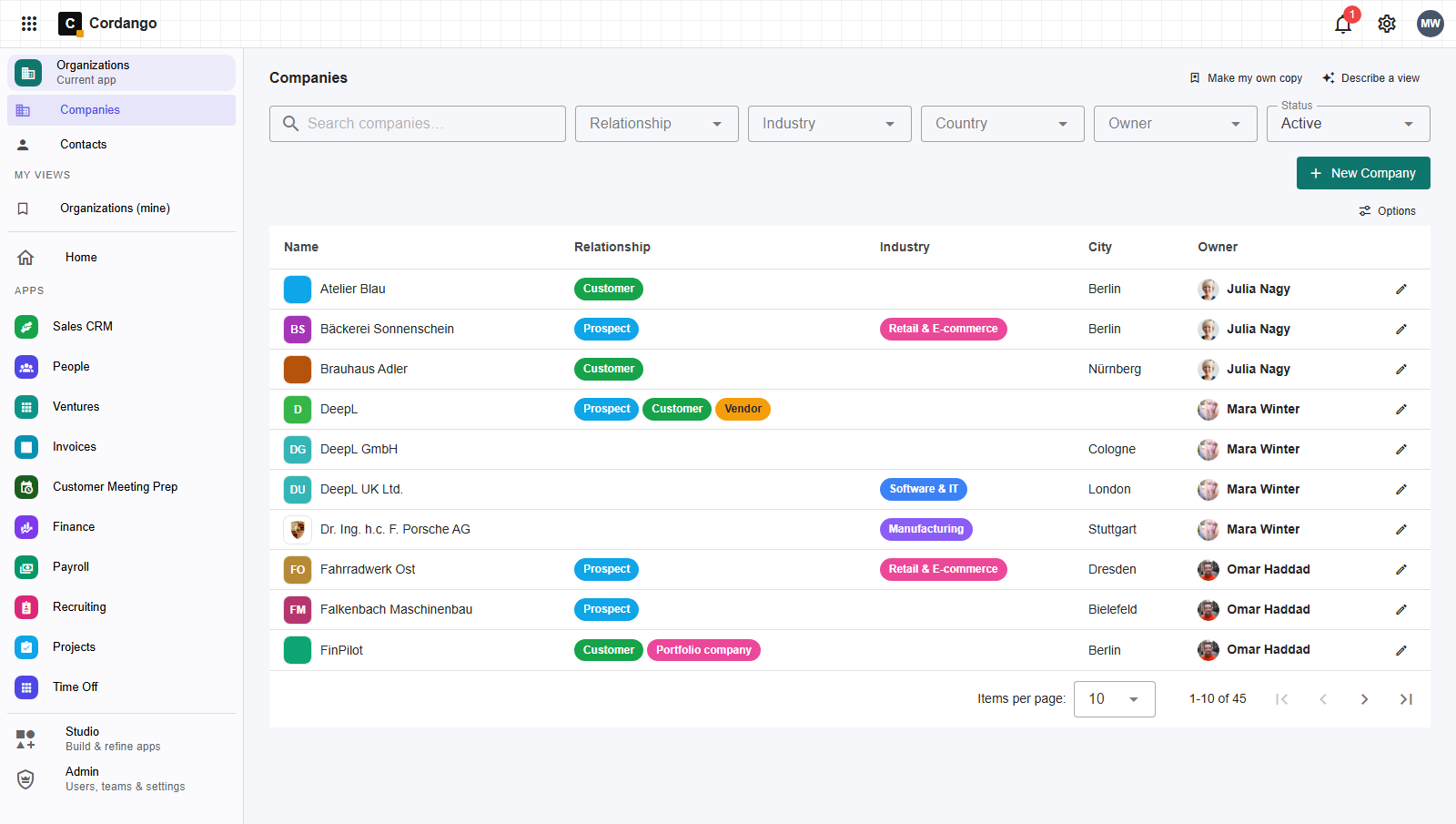
Look at the third row. DeepL is a prospect, a customer and a vendor at the same time, and all three are true. A supplier is often also a customer. A prospect is often already a supplier. Those facts do not expire and they do not contradict each other, so the record holds all of them rather than making you pick.

Look at the first three rows together. DeepL, DeepL GmbH and DeepL UK Ltd are three separate records, because each of them is invoiced, contracted and researched in its own right. What connects them is the group, not a merge.

  • MANY Six relationship types, held at the same time
  • GROUP Each entity its own record, connected by ownership
  • KEEP Nobody deletes a company, because everything points at it
  • FIND Filter by relationship, industry, country, owner or status
Companies · 45 recordsOne list
FIG.08

The record grows as you add capabilities.

Nothing is copied and nothing is synced. Each app adds what it knows to the company that is already there.

FOUNDATION
Company
Legal identityAddressesRelationshipsGroupContactsOwnerResearched profile
+ CRMsales
OpportunitiesPipeline stageLast contactNext step
+ Projectsdelivery
Active projectsDelivery leadMilestonesHours booked
+ Invoicesfinance
InvoicesPaid and openBalancePayment history
+ Supportservice
TicketsOpen issuesResponse times
+ Contractslegal
AgreementsRenewal datesNotice periods
Ask what is going on with a customer and you get one answer, not five tabs.
FIG.09

The record is fixed. What you build around it is yours.

One agreed spelling of every company you deal with is the entire point, so the shared record is deliberately not something each workspace redesigns. Everything particular to your business goes in an app of your own that points at the same company.

YOUR APP

Your fields, on your own app

Our own investment app carries twenty-eight fields about a company: stake, entry date, valuation, thesis, exit proceeds. None of them are on the shared record, and all of them hang off it.

NO WIRING

It shows up by itself

An app that references a company gets a place on the company page the day it is built. There is no core definition to edit and nothing to remember.

YOUR VIEW

Your own way of looking at it

Build your own pages and saved filters over Organizations, or describe the view you want in a sentence. Shared as a link, it carries the layout and none of the data.

Your own fields on the shared record itself are in build. See the roadmap →

NEXT

Bring one customer that lives in three systems.

Bring a company you deal with and we will put it in, research it while you watch, and show you what every app in the workspace already knows about it.

About 30 minutes, on a real company platform